Piqsal Case Study
Record once, personalise every video:a GenAI video outreach platform
Ten months of freelance work as the only designer, from empty file to launched product. I broke the link between how personal a sales video feels and how long it takes to make.
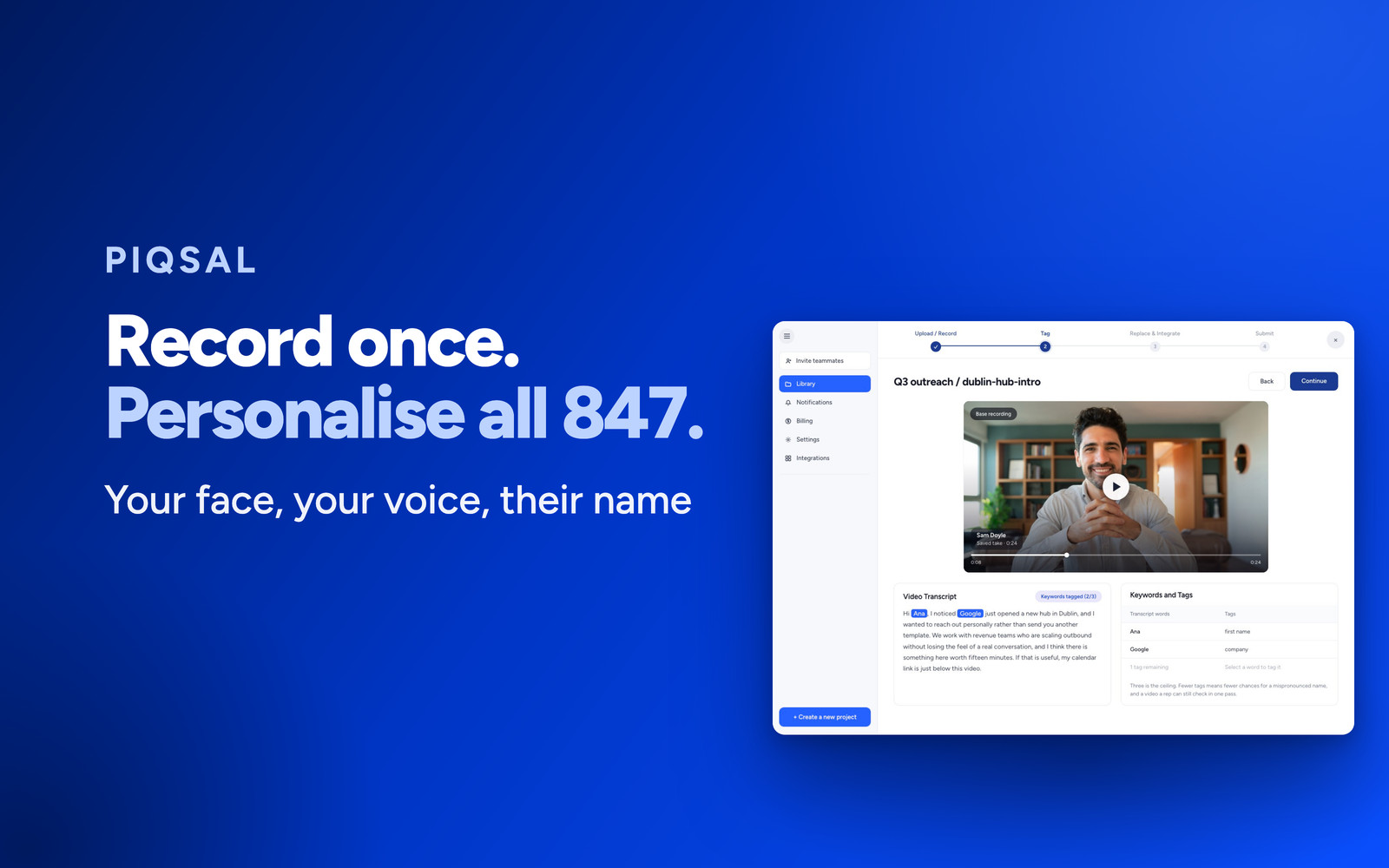
Overview
A personalised sales video gets replies. The problem is arithmetic: to reach 800 prospects, a rep records 800 videos. Piqsal breaks that link. You record one take, and the models make the other 846, each one carrying the prospect's name and company in your own voice. The hard part was never the AI. It was that nobody sends a video with their own face on it until they have checked it.
Goals:
- Break the link between how personal a video feels and how long it takes to make.
- Turn a set of AI capabilities into one workflow a non-technical rep can finish alone.
- Design for three very different customers without shipping three products.
The Challenge
What was happening
Sales teams knew video worked, and knew it did not scale. So they used it on the ten accounts that mattered and emailed everyone else. Personalisation was rationed because it cost a recording each.
"I know the video works. I can't record four hundred of them."
An early design partner, describing the exact trade every rep was making.Two founders hired me for this, freelance, and they are two of the sharpest people I have worked with. They already had the models: lip-sync, voice cloning, keyword replacement in the transcript. What they did not have was a product. Each model made a convincing clip on its own, and none of them answered the questions a rep asks on Monday morning. What do I upload first? How do I check eight hundred videos with my own face on them?
Take a set of impressive AI demos to market as one purchasable product, and land it with solo reps, sales teams, and enterprise buyers alike.
Send something that feels personal to every prospect on my list, without recording it every time or risking my name on a bad take.
Problem to solve
Effort grew with every prospect, so personalisation stayed rationed. The models could break that link. Nothing in the product yet told a rep what the AI had changed, or why to trust it.
videos recorded per prospect reached, before any of this. That ratio was the whole problem
Research
There was no product to test, so research meant understanding the job, not the interface. I interviewed reps and founders who did their own outreach, walked their sequences step by step, and studied how Loom and Vidyard handled recording. I also sat with the ML engineers, because where the models broke had to shape the interface.
Every prospect a rep wanted to reach personally cost another recording, so the list size and the workload were the same number.
Which is why personalisation was rationed to the top ten accounts.
outreach campaign
one video
for the whole list
The bottom row is the product.
Nobody cared how many videos the system could make until they had seen one and believed it sounded like them. Review sold the product, not scale.
Reps did not think in tags and variables. They thought in CRM lists and spreadsheets, so whatever we built had to meet the messy CSV they already had.
The models were good but not perfect, and their weak spot was the thing that mattered: names. An unusual company or surname was where pronunciation drifted. So generation could not be a black box with a send button. Those few words are the whole value and the whole risk, so they had to be visible and editable.
Who I was designing for
Three kinds of customer, one product. I treated the AI as a fourth actor with its own obligations.
The solo rep
Founder or AE, own pipeline"I need to send something good tonight, and I'm the only one who can check it."
The sales team
Manager plus five to fifty reps"Everyone should be sending the approved message, not their own version of it."
The AI
The models, as an actor"Show exactly which words I changed, and let them fix the ones I got wrong."
How might we
How might we let one person send a genuinely personal video to a thousand prospects, when the personal part is generated by a model they have no reason to trust yet?
where the models were weakest, and where all the value sat. So the interface had to show those words, not hide them
Design Strategy
One reframe set the direction: the personalisation is a handful of words, so design the product around those words. A rep is not making a thousand videos, they are replacing two or three words a thousand times. That made the workflow obvious. Record, tag, replace, generate. Four steps, in that order, every time.
That gave one path the whole product could hang off, which mattered with three kinds of customer and one small team. So instead of a solo mode and a team mode, the workspace carries the difference. Same path, different container.
The four calls I had to defend
In three of the four I argued for less product than the models could deliver.
Cap personalisation at three tags, and show the count
Deeper personalisation the models could already do.
Names were the models' weakest point. A few tags carry almost all of the personal feel, and a count teaches the limit on first use.
One straight workflow for all three customers
Power-user shortcuts for enterprise.
All three did the same four steps. Putting the difference in workspace structure let one team ship for three buyers.
Sample one video before generating the rest
The fastest possible path to send.
Nobody was persuaded by how many videos it could make. They were persuaded by hearing themselves. The extra step won people over rather than slowing them down.
Show the transcript, not just the output
The cleaner black-box demo the founders wanted.
A rep is putting their own face on the output. Hiding what the AI changed makes it better to watch and impossible to trust.
Where the tag cap actually came from
That decision did not arrive as a decision. It sat in my working file for weeks as a note to myself, next to the screens it was blocking.
From the working file
- User can input upto two words consequetively as input
- Showing error when user has entered two words from different sentences
- How many tags can a user select? We need to give clear indicatio.
- 3 Tags and when user clicks the 4th word in te
What shipped, and why
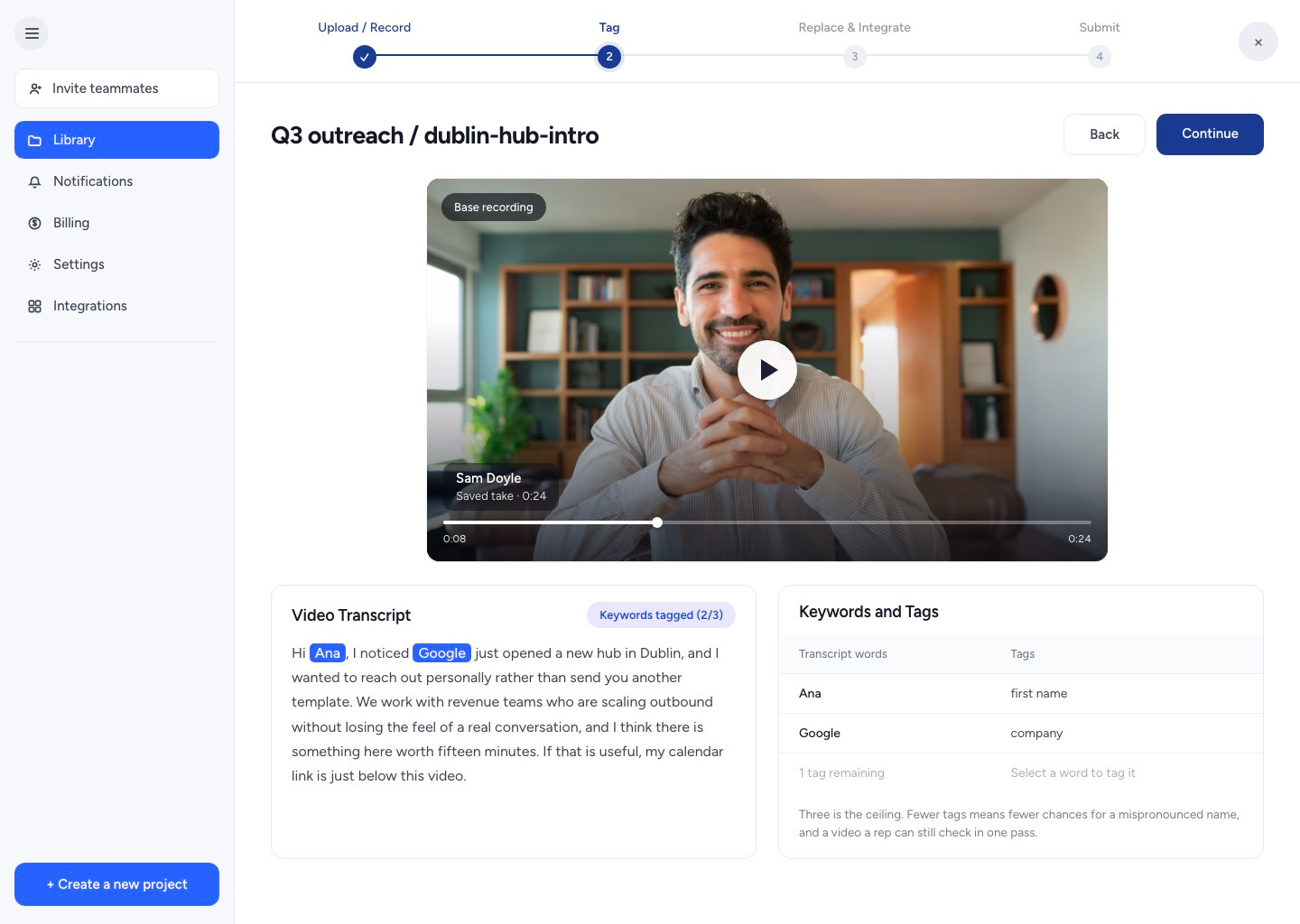
Three shipped. Every tag is another chance for the model to mispronounce a name, and another thing a reviewer has to hold in mind, so a low number was never in doubt. Where exactly to stop was. Three is the point where a rep can still name a prospect, their company and one specific thing about them, which is the whole content of a warm opener, without the video reading like a filled-in form.
The half-finished lines matter more than the number. "We need to give clear indicatio…" is me catching that a cap is worthless if the interface does not say it out loud. A rep who hits an invisible ceiling on the fourth word learns the product is broken, not that a limit exists. That is why the screen carries a running count instead of a silent block. The note stops mid-word because I went and designed the counter.
The count is on screen as the rep tags, so the ceiling teaches itself on first use instead of arriving as an error
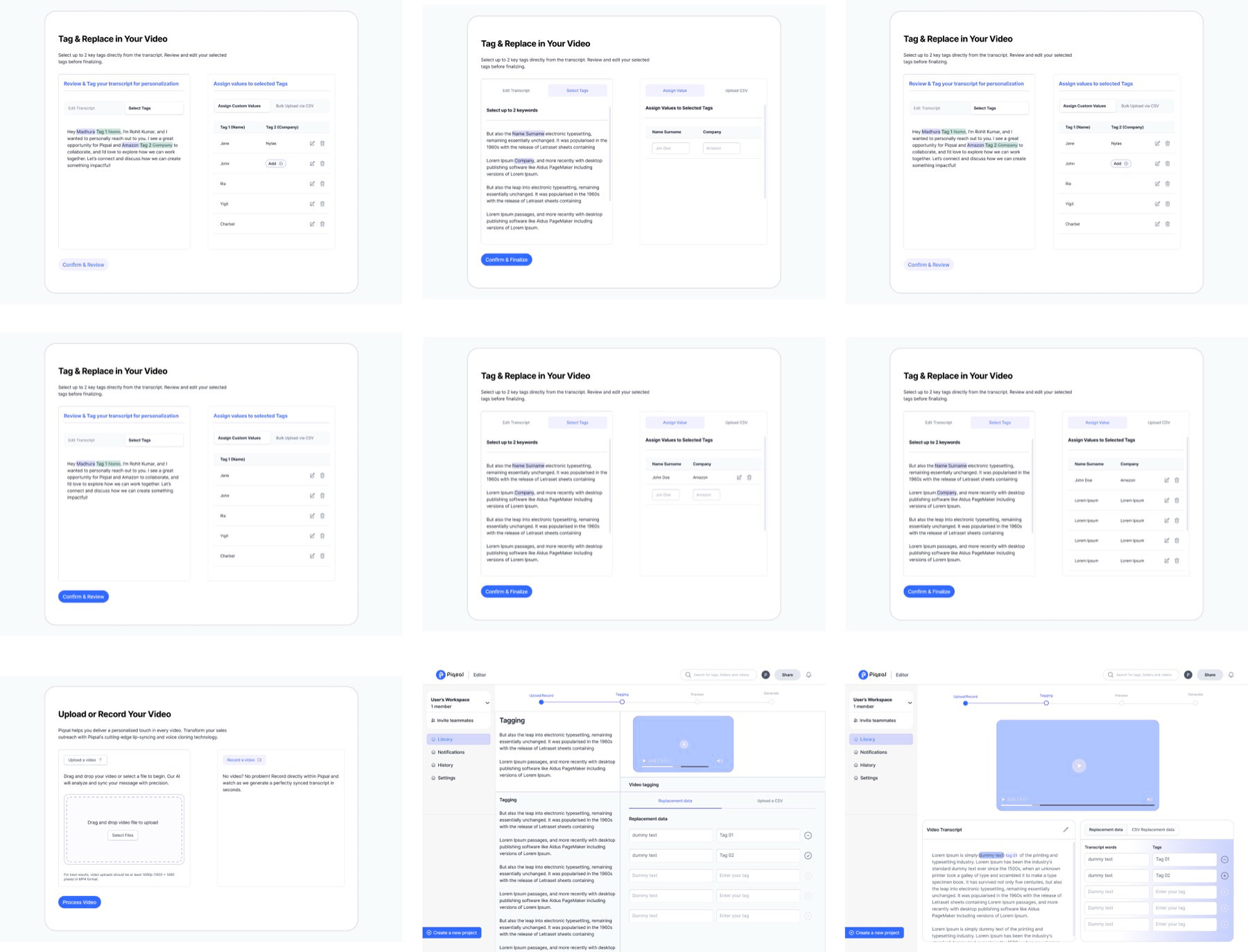
How it got to four steps
Four steps was the answer, not the starting point. I worked the tagging step through a lot of versions.
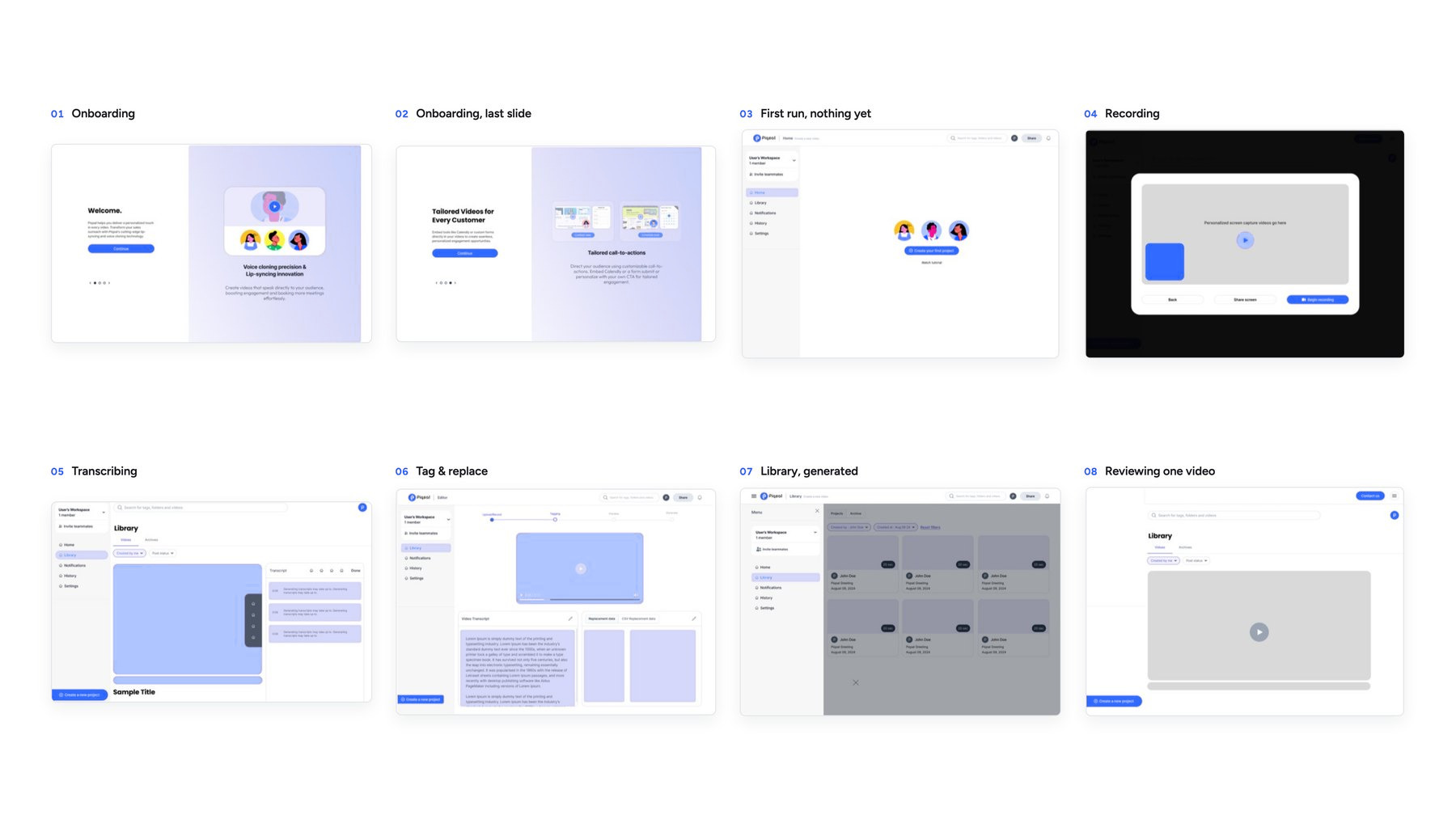
Solution
One campaign workflow, four steps, in a workspace that scales from one person to a team. The AI works inside two of the steps; everything else exists to make that work checkable.
Upload / record
The one base video every generated video comes from.
Tag
Pick the words to swap. Three at most, counted on screen.
Replace & integrate
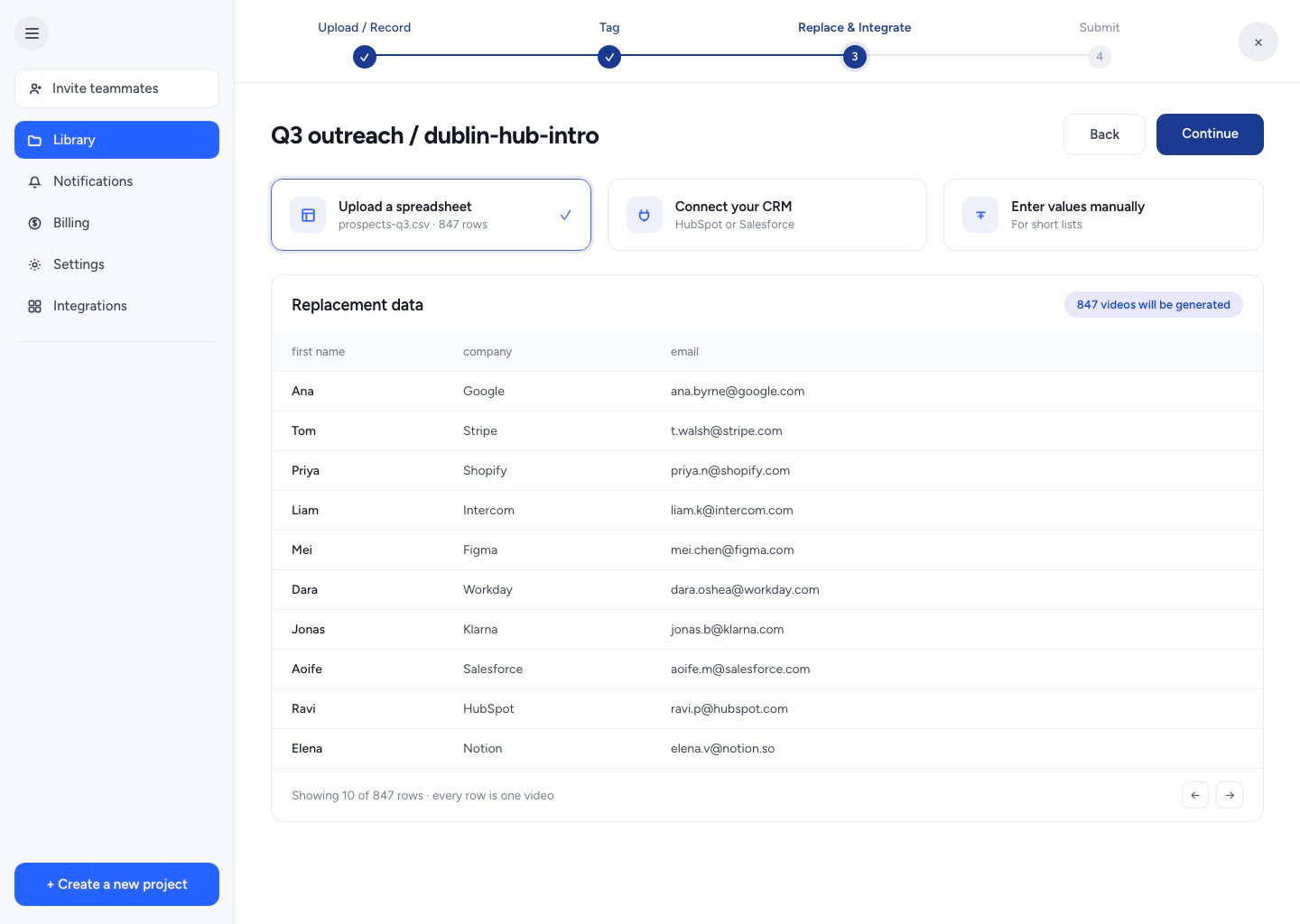
Spreadsheet, CRM or typed in. One row, one video.
Submit
The sample and the cost, then the run starts.
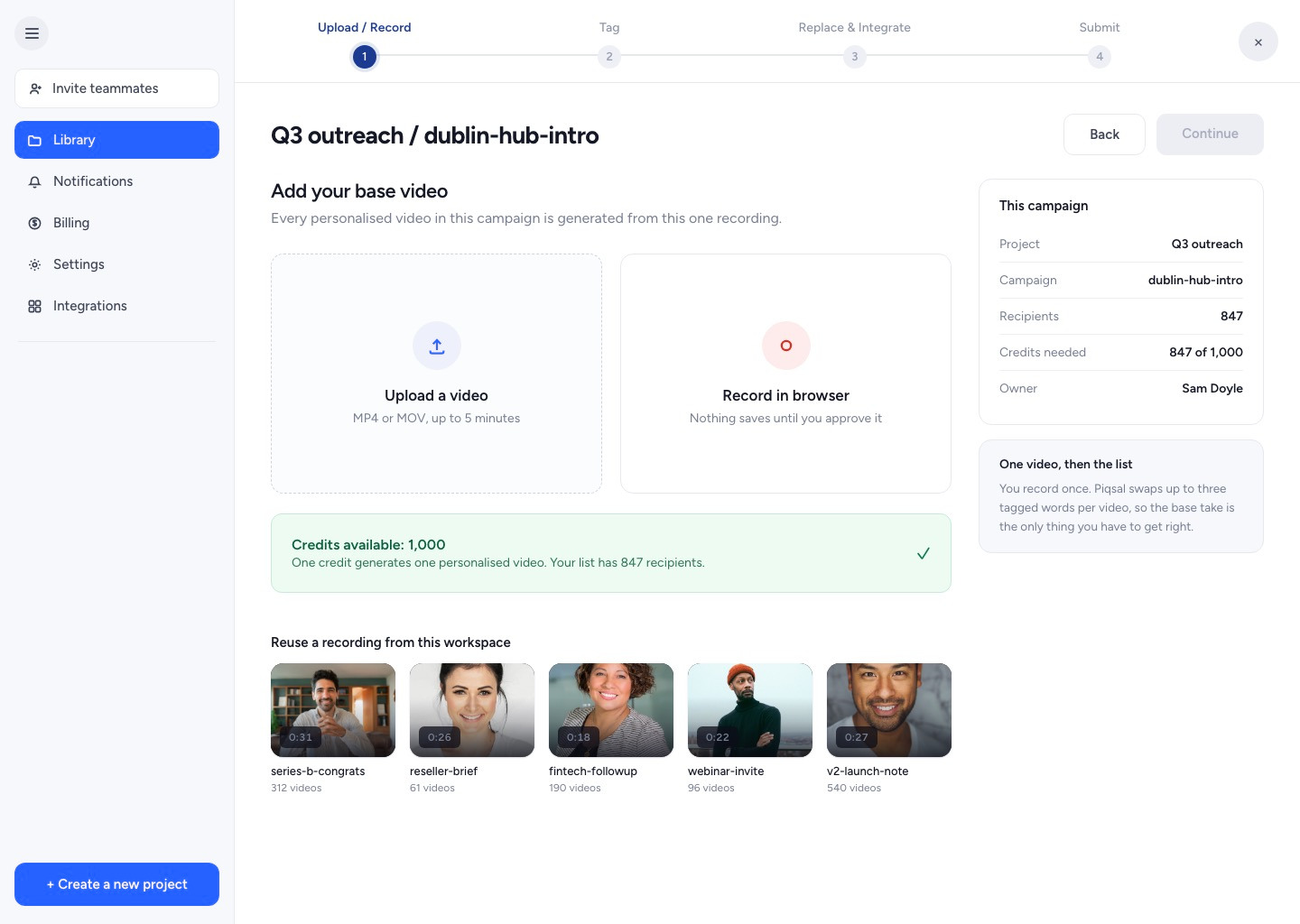
Step 1: the cost, before the effort
The flow opens by naming what the campaign will cost before a rep spends a minute on it: 847 people on the list, 1,000 credits in the workspace, one credit per video. The two ways in sit side by side as equals, and Continue stays disabled until one of them has produced something.
Recording, designed to be thrown away
Step one looked trivial on the flow diagram and was the hardest thing to get right. Reps hated recording themselves, and when a take felt final they stalled rather than risk it being the one cloned eight hundred times. So I made recording something you throw away: one dark panel, the state named out loud, and a watch-back before anything saves, with discard and save drawn as equals.
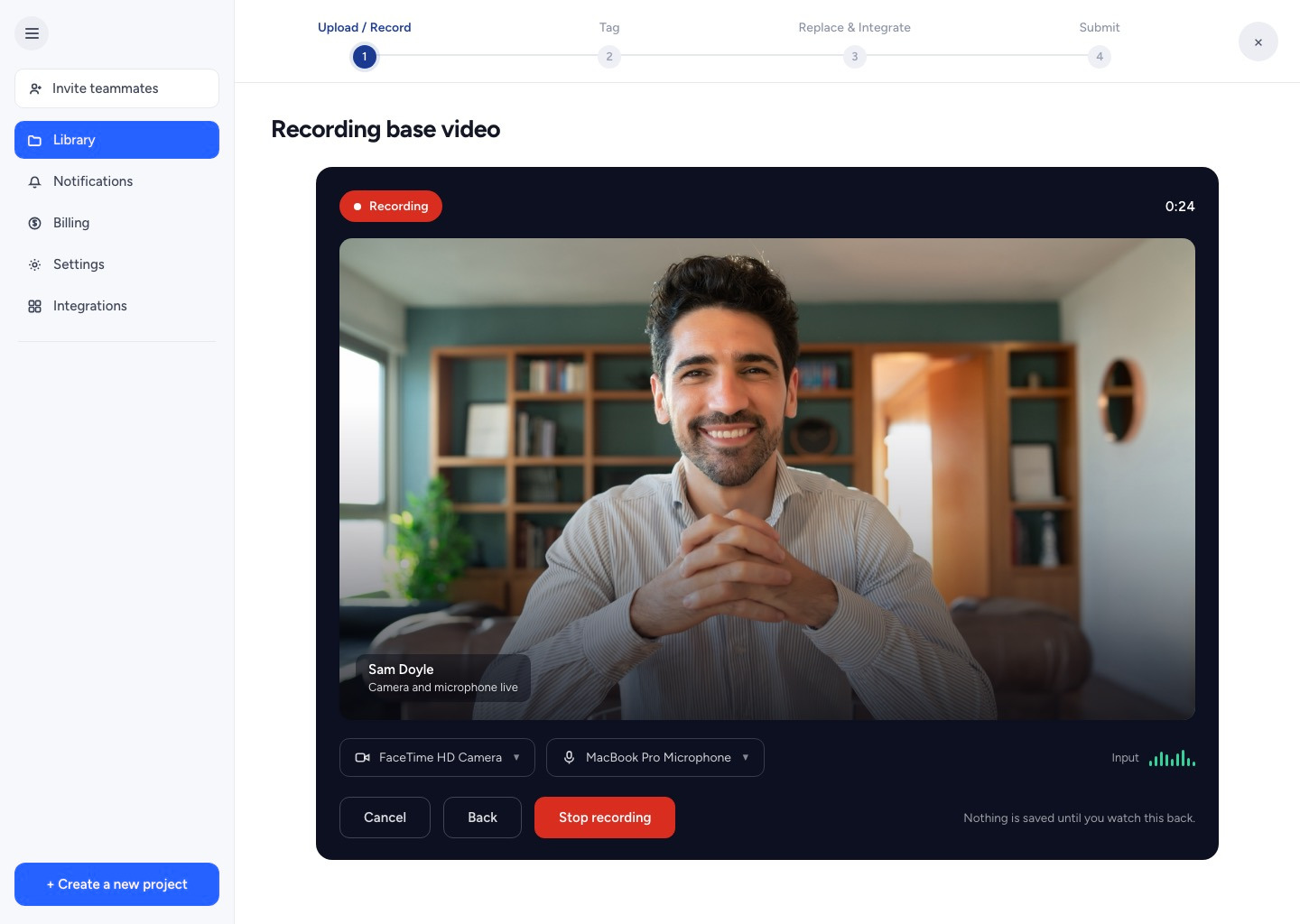
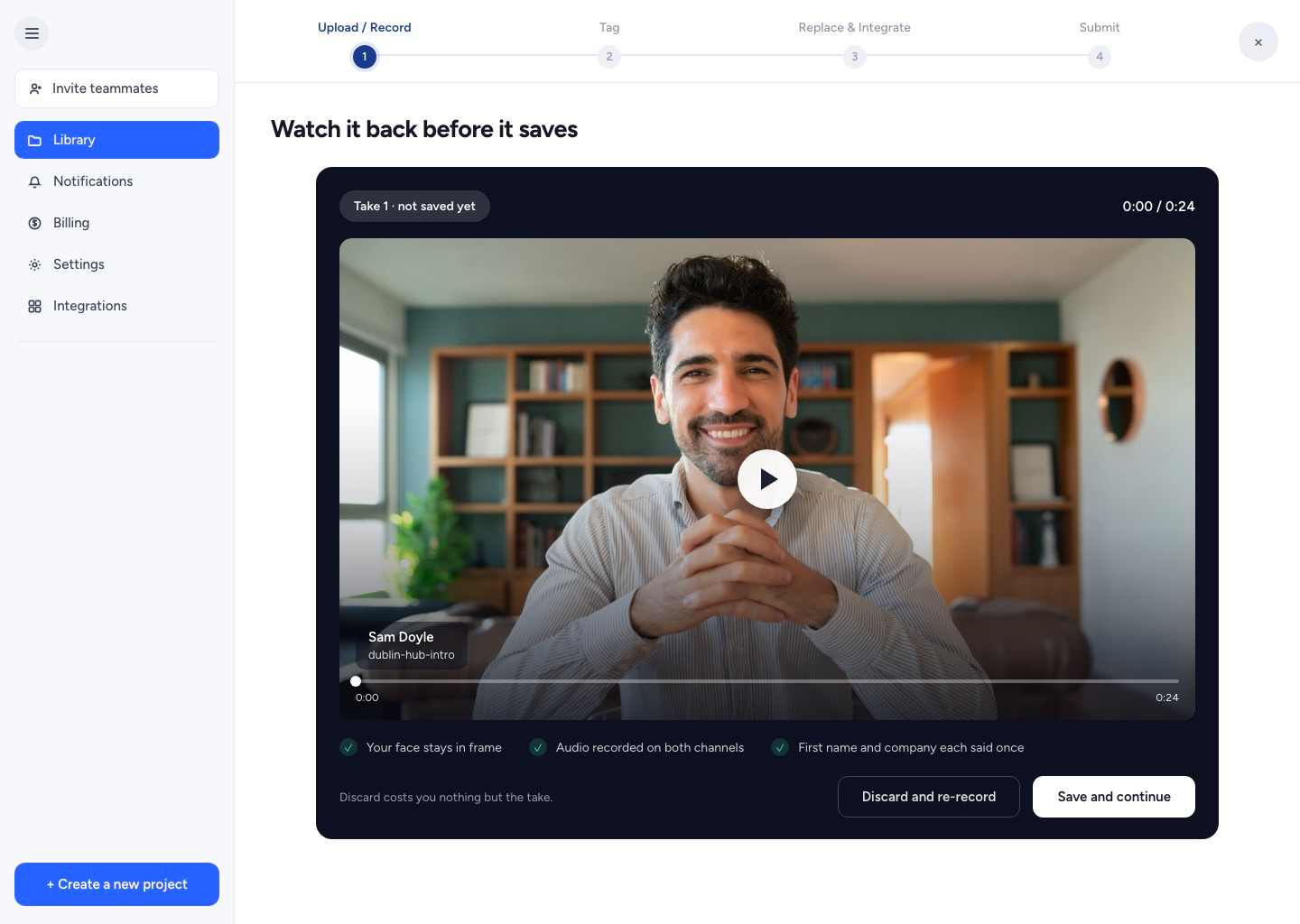
Step 2: the tag cap, made visible
With a take saved, the product transcribes it and hands the rep the only decision the model needs: which words get swapped. This is where the cap stops being policy and becomes something on screen: the header counts "Keywords tagged (2/3)", so nobody discovers the ceiling by hitting it.
Step 3: the list a rep already has
Reps arrive holding their list in three different places, so there are three doors into the same table: a spreadsheet, a CRM connection, or typed values. None of them asks a rep to rebuild data they already own. Once the data lands, one row is one video, the header states that 847 videos will be generated, and the footer admits it is showing ten of 847 rows.
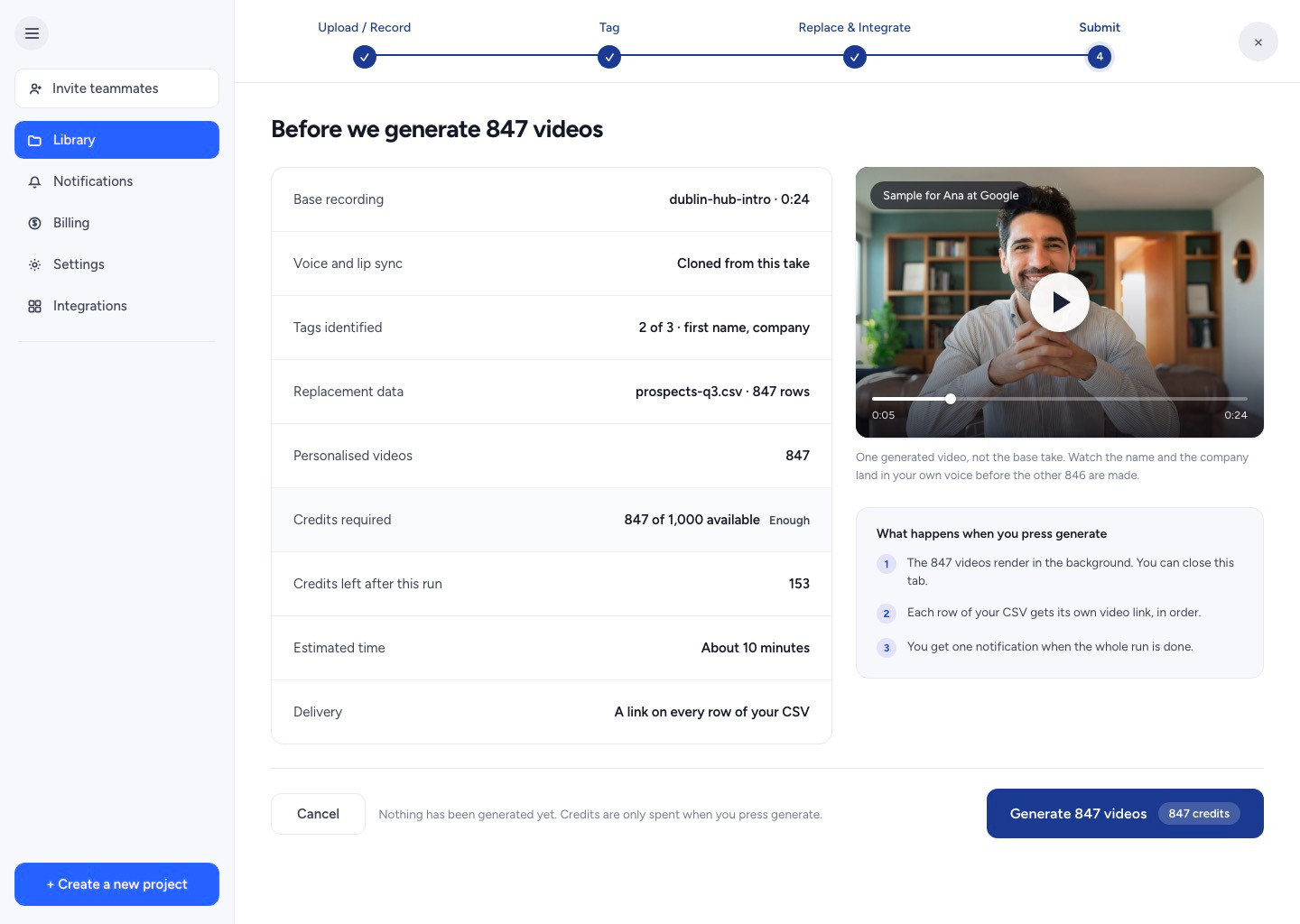
Step 4: the last screen is a bill
Nothing generates until a rep passes one more screen, the only place where I put a wall in the way on purpose. Everything before it can be undone, so the whole promise of undo rests on this screen being honest. It summarises rather than confirms: duration, tags found, videos to be made, credits required against credits available, estimated time, and the sample video itself beside the cost.
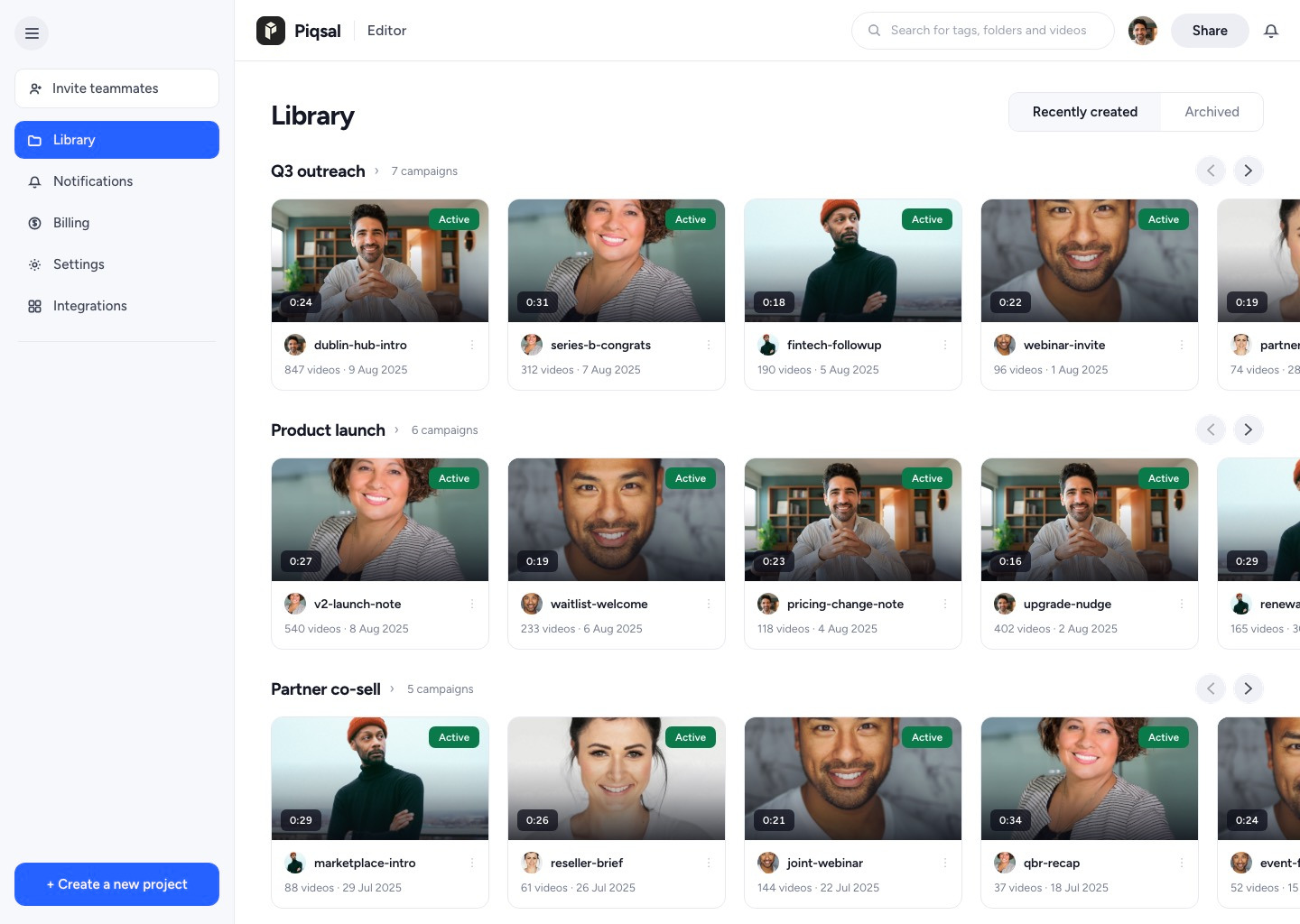
The workspace that made three customer types one product
The four steps only stay four steps if everything else has somewhere to live. A workspace holds projects, a project holds campaigns, a campaign holds the videos. Workspace membership is the only thing that differs between a solo rep and a fifty-person team, and every screen outside the flow hangs off those four things: team, billing, integrations, statistics.
What the four steps changed
The rep's job did not get easier by a percentage. It changed shape.
Records ten videos for the ten accounts worth the effort, and sends everyone else the same cold email.
Records once, uploads the list, watches one sample, sends 847 videos that each say the right name.
Every rep improvises their own message. No shared base, no visibility on what actually went out.
One approved template in a shared library, reused per campaign, with generation status visible per prospect.
Impact
Piqsal went to market with the workflow, the workspace and the brand I designed. The pilot campaigns are where the four steps got their answer.
Reply rate against cold email, in pilot campaigns
Same rep, same list, one recording instead of hundreds.
"Madhura designed Piqsal end-to-end, turning our vision into a polished and intuitive product experience."
Rohit Kumar, Co-founder, PiqsalWhat I learned
Constrain the AI where it is weakest
Capping personalisation at three tags was the most important decision in the product. The models could do more, and doing more would have cost the trust everything depended on. The limit was the feature.
The hard step is the one nobody flags
"Record a video" was one box on the flow diagram and the place people actually stalled. The blocker was being on camera, not the AI, so no amount of model work would have found it. Testing did.
Scale is a promise, review is the product
Nobody was persuaded by how many videos the system could make. They were persuaded by watching one and hearing their own voice. That step won people over and never once slowed a rep down.
One path beats three products
Solo, team and enterprise all did the same four steps. Putting the difference in the workspace instead of the flow is what let one designer serve all three without building three products.
What I'd do differently
Test the record step in week one, not week six. Being on camera was the real blocker and I found it late. And add tracking before launch: we shipped with campaign numbers but no way to see where people gave up.
when I finally tested the step reps were most afraid of